When a tree starts leaning toward your roof or drops big limbs into the yard, it stops being a backyard feature and turns into a full-on problem. Tree Removal in Greenville, SC is usually the call folks make when they can see the danger with their own eyes, like bark splitting or roots lifting the soil near the driveway. Around Greenville, SC, trees can sit close to homes, fences, and power lines, so there’s not much room for guessing. Once you notice the risk, getting a plan together fast is the safest move.
- Visible lean, sudden cracking, or heavy deadwood that wasn’t there last month
- Limited drop zones in Greenville yards with tight fences, patios, and landscaping
- Removal done wrong can damage roofs, gutters, and underground utilities
What That Problem Usually Means
A tree rarely goes from healthy to hazardous overnight, even if it feels that way when a limb hits the ground. Most of the time, we’re dealing with structural weakness caused by internal decay, old storm damage, soil issues, or a root problem you can’t see from the porch. In Greenville, it’s common for trouble to show up after a stretch of wet ground and then one windy afternoon that pushes the tree past its limit. If a tree is threatening your home or blocking access, removal is often the safest choice instead of trying to trim around a bigger problem.
Sometimes the issue is that the tree is alive but in the wrong place, and it’s outgrown the space it was planted in. That’s where risk assessment matters, because a tree over a roofline, over a driveway, or near a service drop can’t just be dropped like it’s in the woods. We look at what the tree could hit, how it’s weighted, and what we’ve got for access to safely rig it down. If you’re seeing fresh soil heaving near the base, that can point to root plate movement and it’s not something to wait on.
Other times, the problem is obvious because the tree is already failing in pieces. You might notice big dead sections up top, mushrooms at the base, or a long split running down the trunk, and that’s typically trunk decay showing itself late in the game. Trees can look fine from the street and still be hollow enough to fold when they catch a gust. We’d rather talk you through the options before it turns into an emergency with a blocked driveway or a dented roof.
- Lean and root lift can indicate the tree’s holding power is already compromised
- Cracks and cavities often mean there’s less solid wood than you think
- If targets are nearby, a controlled removal plan is usually the safest path
Warning Signs Homeowners Miss
A lot of folks only look up at the canopy, but the ground tells the story first. When we see root damage signs like soil cracking in a half-moon shape, sinking ground, or raised roots near the sidewalk, it can mean the tree is shifting or losing grip. In neighborhoods with established trees and tight lots, those early clues matter because there’s not much margin for error. If the tree is close to your home, those little changes can be the difference between scheduling removal and dealing with a sudden failure.
Another easy-to-miss sign is when the tree drops limbs that look alive, not dead. That’s often tied to stress shedding, where the tree is basically giving up weight because it can’t support itself like it used to. You might also notice leaves thinning out unevenly, bark peeling in patches, or a limb that suddenly sits lower than it used to. If you’re walking out to get the mail and hearing creaks or pops from the trunk on windy days, that’s worth taking seriously.
We also watch for trees that are fighting for space with structures and utilities. A tree can be ‘fine’ biologically but still be a hazard when the canopy is rubbing the roof, limbs are over the driveway, or the trunk is too close to a fence line. That’s where clearance issues become a real concern, especially if you’re near busier roads like Wade Hampton Boulevard or Butler Road where a falling limb can cause bigger problems than just yard damage. If you can’t picture where the tree would land without hitting something important, it’s time to call it in.
- Ground movement near the base is often the earliest warning sign
- Live limb drop can be stress, not ‘just normal’ shedding
- If there’s no safe landing zone, removal needs controlled rigging
How We Handle Tree Removal in Greenville, SC
When we show up, we’re not guessing and we’re not rushing straight to the saw. For Tree Removal in Greenville, SC, we start with a site walk to look at targets like roofs, gutters, fences, sheds, driveways, and overhead lines. We’ll talk through what you’re worried about and what the tree is doing, because homeowners usually spot the first changes before anybody else. Then we map out how each section comes down and where the debris is going to go.
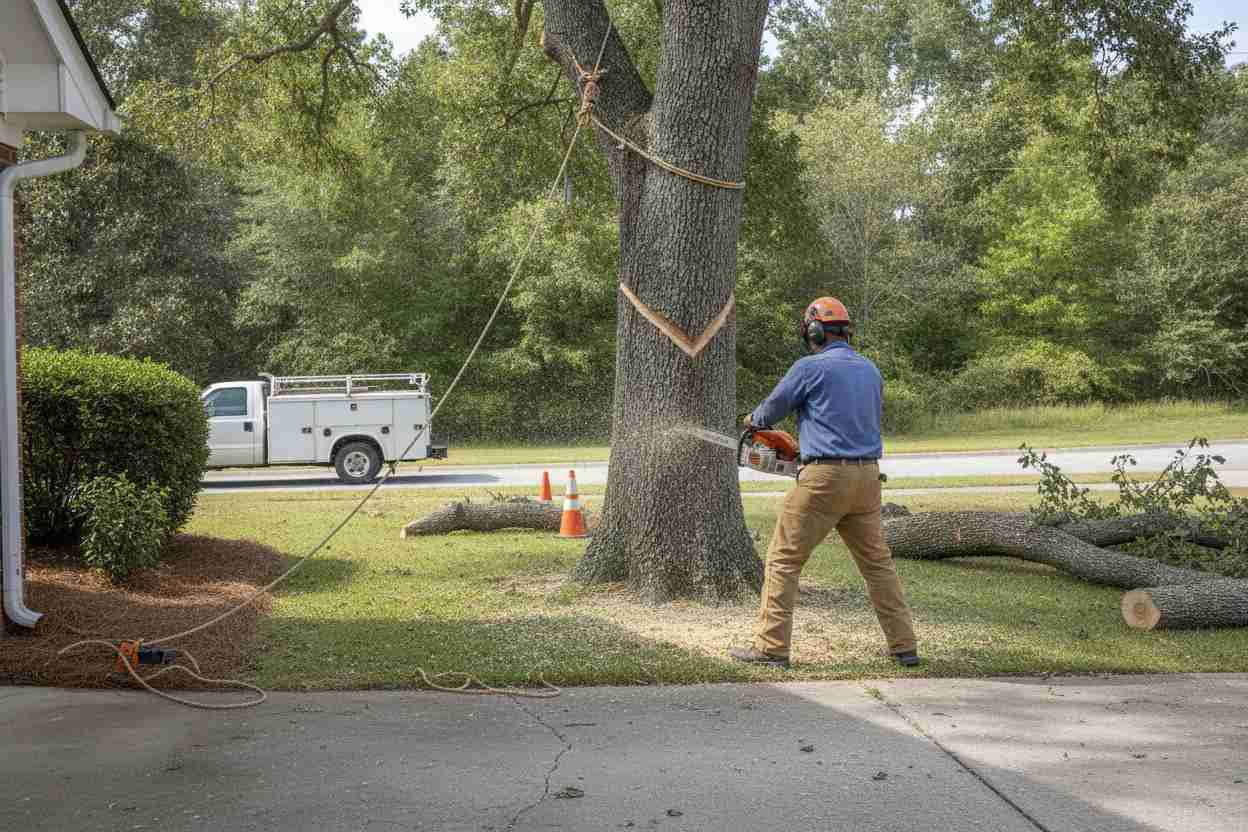
Most Greenville residential removals aren’t ‘one cut and done’ because there’s just too much around the tree. That’s why we use sectional removal, taking the tree down in pieces and controlling the fall with rigging when needed. We’ll set a drop zone if we can, protect what needs protecting, and keep the work area tight so we’re not tearing up the whole yard. You’ll hear the saw, sure, but what you shouldn’t hear is chaos, because controlled cutting is the whole point.
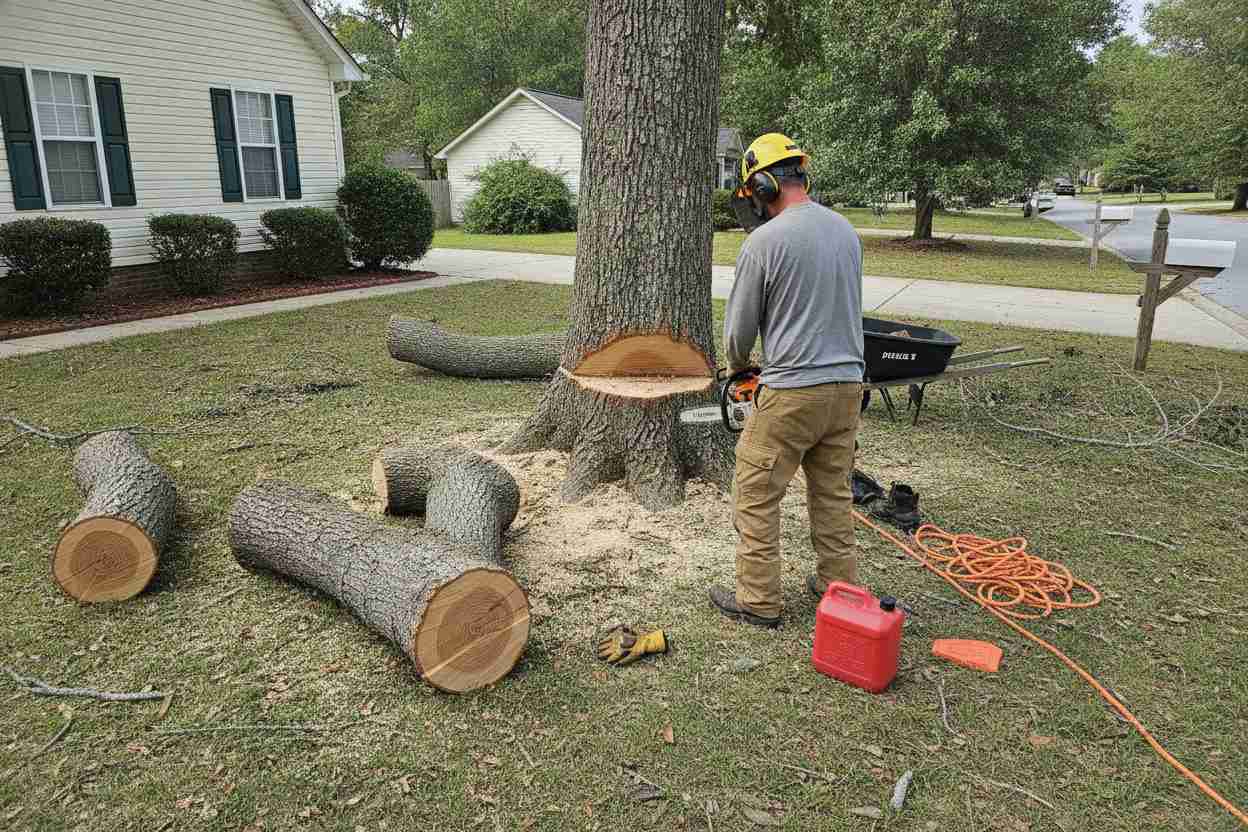
After the tree is down, we don’t leave you staring at a mess. Cleanup is part of doing the job right, and debris hauling is usually what homeowners care about once the adrenaline wears off and they just want their yard back. We’ll stack, chip, and remove material based on what’s best for your property and access. If you want the stump addressed too, we’ll explain what that involves and what you can realistically expect for ground disturbance.
- We plan the removal around what the tree could hit, not just the easiest cut
- Piece-by-piece removal keeps homes, fences, and driveways protected
- Cleanup and hauling are handled so your yard isn’t left looking like a jobsite
Types Of Projects We Do
Not every removal is a storm emergency, even if it feels urgent when the tree is in your line of sight every time you pull into the driveway. We handle hazard removals when trees are dead, splitting, leaning, or dropping heavy limbs close to homes and parked vehicles. A lot of calls come from folks near older neighborhoods and established lots where big trees grew up before the house or addition went in. The goal is always the same: get the risk down without turning your property into a crater.
We also remove trees that are simply in the way of how you use the property now. That includes trees blocking a new fence line, crowding out sunlight, or sitting too close to patios and play areas, and that’s where property clearance becomes the practical reason for removal. It’s not about hating trees, it’s about making the yard usable and safe. We’ll walk through how the tree comes down, where equipment can access, and what to expect with cleanup.
Then there are the tricky removals where there’s almost no room to work, like trees between houses, over driveways, or behind tight backyard gates. Those jobs lean hard on rigging control, because we’re lowering limbs and sections instead of letting anything fall free. If you’re near places like Downtown Greenville where properties can be tighter and access can be more limited, we’ll be upfront about what it takes to do it safely. The right setup and patience matter more than speed on these removals.
- Dead, leaning, split, or limb-dropping trees near structures
- Removals for yard use, clearance, and long-term property plans
- Tight-access removals where controlled lowering is the only safe option
What Affects Cost and Scope for Tree Removal in Greenville, SC
Tree removal pricing isn’t one-size-fits-all, and anybody who gives you a number without looking is just guessing. For Tree Removal in Greenville, SC, the biggest driver is usually target proximity, meaning what the tree can hit if anything goes wrong. A tree out in the open is a different job than one hanging over shingles, a carport, or a power line. We’ll explain what makes your situation simpler or more complex so you understand what you’re paying for.
Access is another big deal, and it’s something homeowners don’t always think about until they see the crew figuring out a path into the backyard. Gates, slopes, landscaping, retaining walls, and tight driveways can change the whole approach, and equipment access can determine whether we can bring in larger tools or we have to work more by hand. If you’re off a busier route like I-385 or near shopping corridors like Haywood Road, we also plan how trucks and chippers can safely stage without causing headaches. That planning time is part of a professional removal, not an add-on surprise.
Finally, scope can change depending on what you want done after the tree is on the ground. Some homeowners want logs left for firewood, others want everything hauled off, and stump work is its own step. Those choices affect cleanup scope, time on site, and how much disturbance happens in the yard. We’ll be straight about what we can do, what makes sense, and what’s not worth the money for your specific property.
- Risk level goes up fast when the tree is over a roof, driveway, or utility area
- Limited access can change the method and the time required
- Hauling, wood handling, and stump work are separate scope decisions
Why Drop-a-Top Tree Service Is a Trusted Local Choice
When you’re staring at a risky tree, what you want most is a crew that shows up, explains it clearly, and doesn’t talk over your head. Our focus is clear communication, so you know what’s happening, what’s protected, and what the work will look like from start to finish. We’ve been doing this for 10 years, and that experience matters because removals rarely go exactly like the ‘easy’ version in someone’s head. We’d rather be honest about the plan than promise something that doesn’t fit the yard.
We also take the time to protect the parts of your property you care about, because tree work gets real heavy, real fast. Good removals are built on jobsite control, like managing drop zones, keeping debris contained, and coordinating cuts so nothing swings into gutters, windows, or landscaping. If we need to adjust the plan because the tree has hidden decay or a limb is loaded wrong, we’ll tell you why. That’s how you avoid surprises and keep the work safe.
If you want to sanity-check what ‘safe tree work’ should look like, the best guidance is simple: keep people back, keep work planned, and don’t DIY near hazards. The CDC has a solid overview of chainsaw and tree-work risks under tree safety, and it lines up with what we see in the field: heavy wood doesn’t forgive mistakes. You can read it here: https://www.cdc.gov/niosh/topics/logging/default.html. Our job is to keep that risk off your shoulders and handle the removal the right way.
- We explain the plan in plain language and keep you in the loop
- Controlled cutting and protection steps reduce property damage risk
- Experience helps when the tree is worse inside than it looks outside
If you’re dealing with tree problems just outside Greenville, it can help to look at nearby service info so you know what to expect from the process. Our page for local tree care breaks down common services and how we approach them in that area, and it’s a good fit if your property lines up more that way. Take a look here: Tree Services in Taylors, SC. The goal is the same either way: safe work, clear communication, and no mystery steps.
Local Service FAQs
Do I really need Tree Removal in Greenville, SC, or can it be trimmed instead?
Sometimes trimming is enough, but removal is usually the safer call when the tree has a serious lean, trunk cracking, major deadwood, or signs of decay at the base. The key factor is failure risk, which depends on what the tree could hit and how stable it really is. We’ll look at targets like roofs, fences, and driveways and explain the practical options. If trimming would leave you with the same hazard next month, we’ll tell you straight.
What should I do before the crew arrives for removal?
Clear vehicles from the driveway, move patio furniture if it’s near the work area, and keep kids and pets inside. Good site access helps us set up safely and keeps your property from getting scuffed up by repeated foot traffic. If there’s a gate to the backyard, make sure it can open fully and isn’t blocked by planters or storage bins. We’ll handle the actual work zone setup once we’re on site.
Will tree removal damage my yard or driveway?
Any time heavy wood and equipment are involved, some impact is possible, but the plan is built to minimize it. We use controlled lowering when there’s no safe drop zone, and we keep debris and footpaths as contained as the property allows. Driveway edges, lawns, and landscaping are all part of the pre-work walk-through so we know what to protect. We’ll be upfront about what’s realistic based on access, slopes, and ground conditions.
How long does Tree Removal in Greenville, SC usually take?
It depends on size, access, and how close the tree is to structures or lines. A straightforward removal can be faster, while tight jobs with rigging can take longer because piece removal is slower but safer. We’ll give you a realistic time window once we see the tree and the setup area. Cleanup and hauling can also add time if you want everything removed from the property.
If you’ve got a tree that’s making you nervous every time the wind picks up, it’s worth getting eyes on it before it forces the issue. We handle Tree Removal in Greenville, SC with a practical plan, controlled cutting, and cleanup that doesn’t leave you with a wrecked yard. The next step is simple: we come out, look at the tree, talk through options, and explain what the job involves. If removal is the right move, we’ll help you get it handled safely and cleanly.